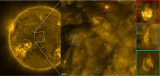
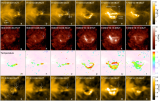
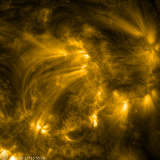
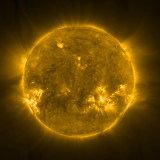
STCE researchers used a sophisticated wavelet-based algorithm to automatically detect and characterize thousands of transient EUV brightenings, often called campfires, in the HRIEUV data obtained at the closest-perihelion of Solar Orbiter.
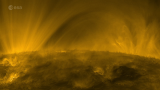
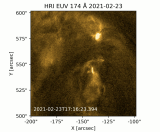
New findings from the European Space Agency’s Solar Orbiter spacecraft reveal that even the tiniest bursts of activity from the Sun may behave like their larger counterparts.
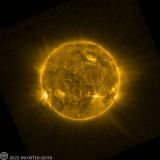
Thanks to a push from planet Venus earlier this year, the orbit of the Solar Orbiter spacecraft was tilted. A century ago mankind raced to explore the poles of the Earth, now Solar Orbiter made its way to the poles of the Sun. For the very first time the solar poles have been imaged!
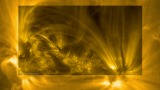
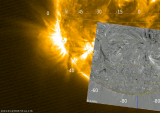
Do you remember the highest resolution image of the Sun ever made? It dates from March 2022 and showed mesmerising details of the solar atmosphere. We decided to do it again. And now we even combined images from two telescopes!
On 8, 9 and 10 April 2025, the SIDC welcomed 85 leading solar physicists, in person and online, to participate in an international workshop on the future of the ESA/NASA Solar Orbiter mission.
Once more, the solar physics team of the Royal Observatory of Belgium invites external researchers to join in the data exploitation of its space telescopes on the PROBA2 microsatellite (SWAP, LYRA) and on Solar Orbiter (EUI).